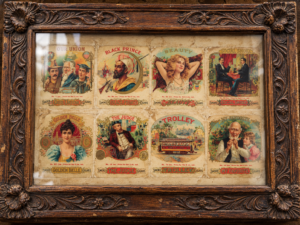

Antique cigar box labels are some of the most beautiful printed art of the late 1800s. Gold edges, raised details and rich colors made them miniature posters for a brand. That beauty is also why so many have been reprinted. Some reprints are sold honestly as decoration. Others turn up described as “vintage” or “antique,” and a new collector can pay original prices for a modern copy. The good news: with a magnifier, a little light and the checks below, you can usually tell the difference in a few minutes.
Why Cigar Box Labels Are Worth Checking
In the 1800s, American cigar makers had to pack cigars in wooden boxes for tax reasons. Thousands of small makers then competed for attention in the same store case. The label on the box was their main advertisement. Printers used chromolithography to make them. Each color was printed one at a time from its own stone, and some labels used more than 20 colors.
Many were then embossed (pressed so parts stand up from the paper) and finished with gold. The best labels come from roughly 1880 to 1910, often called the golden age of cigar label art.
Those same labels are now easy to scan and print. So before you buy, check.
Know the Label Types First
A single cigar box could carry several labels. Knowing which one you are looking at helps you judge size, shape and value:
- Inner label: the detailed picture inside the lid. This is the label most collectors want.
- Outer label: a smaller label on top of the lid.
- End label: a narrow label on the end of the box.
- Edging: thin decorative paper strips along the box edges.
You will also see stock remainders. These are original, unused labels left over in printers’ stock. They are genuine, often in fine condition, and make up many of the original labels sold today. A remainder is not a reprint.
1. Check the Printing Under Magnification
This is the most useful single test. Use a 10x jeweler’s loupe or a strong magnifier:
- Original chromolithograph: colors sit as smooth, solid layers. Shading is built from fine, uneven dots and lines placed by hand, called stippling. The pattern looks a little irregular, because a person drew it.
- Modern reprint: colors are made from tiny round dots in a perfect, repeating grid or rosette pattern. This is called a halftone dot pattern, and it is how most modern printers work. Inkjet prints show fuzzy, scattered spray dots instead.
A neat, even dot pattern across the whole image points to 20th-century printing. Note that some later original labels were also printed this way, so use this test together with the others.
2. Look at the Gold
Gold on golden-age labels was usually applied as metallic bronze powder or leaf. It catches the light, has a slightly raised, grainy feel and often shows gentle wear on high points.
Reprints usually copy the gold with flat yellow or tan ink. Tilt the label under a lamp: real metallic gold flashes; printed “gold” stays dull.
3. Feel for Embossing
Run a finger lightly over the label, or look at it from a low side angle. Many originals have raised areas: medallions, frames, coins and lettering. You can see the matching dents on the back. Most reprints are flat. Some print a fake shadow to look raised. If the back of the label is perfectly flat where the front looks raised, it is printed, not embossed.
4. Check Paper Quality
Original labels were printed on fairly thin paper, sometimes with a satin finish. With age, the paper usually tones slightly, especially at the edges and back. Reprints are often on thick, bright white or glossy photo paper. A quick home test: in a dark room, shine an ultraviolet (black) light on the paper. Many modern papers contain brighteners that glow bright blue. Most old paper does not.
5. Read the Typography and Fonts
The words on a label are full of clues:
- Period fonts. Golden-age labels use ornate, hand-drawn lettering. Clean, modern computer fonts are a warning sign.
- Printer’s name. Many originals carry the lithographer’s name in tiny type along the bottom edge, such as Schmidt & Co. or O.L. Schwencke of New York.
- Things that did not exist yet. A ZIP code (introduced in 1963), a phone number on an “1890s” label, or a website address all mean the label is later than claimed.
6. Look for Alterations
Not every problem is a full reprint. Some original labels have been changed to look better or sell higher. Watch for:
- Trimmed margins to remove damage or a printer’s name.
- Added color or touched-up areas, which look different in tone under magnification.
- Fake gold added to a label that never had it.
- Glue stains and torn backs, which show a label was steamed off a box. This is not a fake, but it lowers value compared with a clean remainder.
- Married boxes: an original label glued onto a different or newer box.
7. Inspect the Whole Box
If the label is still on a box, the box can confirm its age. Old American cigar boxes usually carry:
- A caution notice, a printed legal notice saying the maker had followed the law and warning people not to reuse the box or its tax stamp.
- A factory number and tax district, stamped or branded on the bottom, plus the number of cigars in the box.
- Tax stamp remnants, often a strip of paper running over the lid seam.
- Sometimes a stamped wrapper shade, the color grade of the cigar’s outer leaf, such as Claro or Maduro.
A label that looks 1890s on a box with no caution notice, no factory number and modern staples deserves a closer look. Our John Ruskin Perfecto Extra cigar box, made around 1948 to 1952, shows lithographed labels with its original tax stamp remnants still in place.
Quick Cigar Box Label Inspection Checklist
| Check | Original usually shows | Reprint usually shows |
|---|---|---|
| Printing (10x) | Solid color layers, hand-placed stippling | Even halftone grid or inkjet spray |
| Gold | Metallic, raised, catches light | Flat yellow or tan ink |
| Embossing | Raised areas, dents on the back | Flat, or printed shadow |
| Paper | Thin, age-toned, little UV glow | Thick, bright white or glossy, glows under UV |
| Typography | Ornate lettering, printer's name | Modern fonts, anachronisms |
Are Reprints Worth Anything?
Reprints have a place. They are cheap, colorful and fine for framing in a kitchen or bar. The problem is only when a reprint is sold as an original. If a label is priced well below others of the same design, ask why before you buy. When you buy an original, ask the seller what type of label it is (inner, outer, end or remainder), whether it came off a box and whether anything has been repaired.
FAQs
- How can I tell if a cigar box label is original?
Look at the printing under 10x magnification, check for real metallic gold and embossing, and compare the paper, fonts and any printer’s name with documented originals. - What is a chromolithograph cigar label?
It is a label printed one color at a time from separate stones, giving rich, solid colors. Most golden-age cigar box labels (about 1880 to 1910) were made this way. - Are cigar box label remainders real?
Yes. Remainders are original labels that were printed but never used on a box. They are genuine and often in excellent condition. - What is the caution notice on a cigar box?
It is a printed legal notice on old American cigar boxes stating that the maker followed the tax law and warning people not to reuse the box or its stamp. - Are reproduction cigar box labels worth anything?
They are usually worth a few dollars as decoration. They only become a problem when sold as originals.