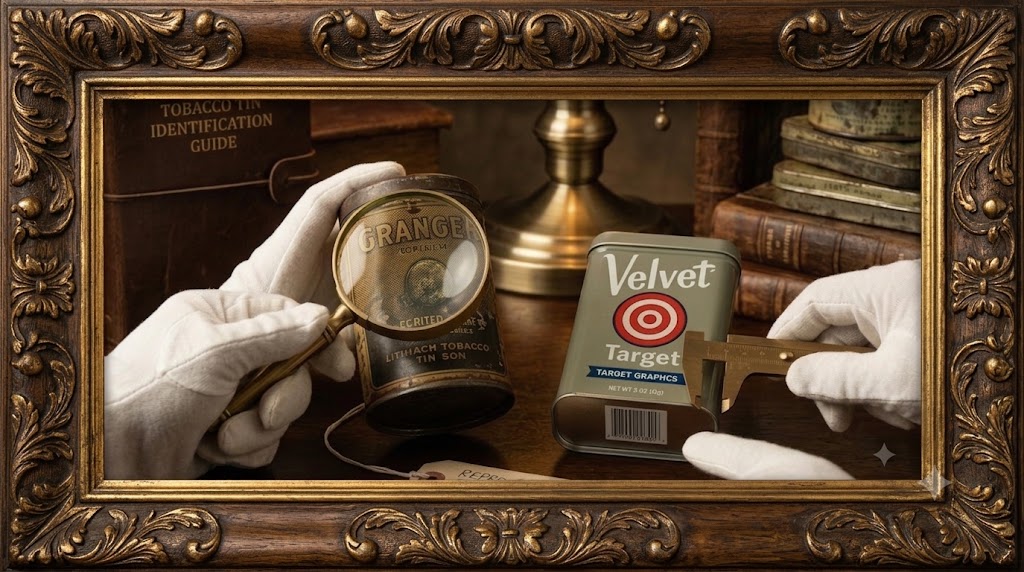
As vintage tobacco tins have grown more collectible, reproductions have grown more common. Some are sold honestly as reproductions; others are passed off as the real thing. For a collector, knowing how to tell the difference protects both your money and your collection. Here are five tells worth checking before you buy.
1. Look for a barcode. This is the fastest disqualifier. Barcodes didn’t appear on consumer packaging until the 1970s, so any tin bearing one was made in recent decades. A barcode doesn’t always mean a deliberate fake — it may simply be a later product — but it does mean the tin isn’t an early collectible, and it shouldn’t carry an early collectible’s price.
2. Examine the printing. Authentic vintage tins were produced using offset lithography, a technique developed in the 1870s and patented in 1875 specifically to print on tin. Period lithography has a particular depth and richness, and under close inspection you can often see the fine characteristics of the process. Modern reproductions are frequently printed with digital methods that look flatter, sharper in the wrong ways, or slightly “off” in color when compared to a known original.
3. Feel the weight and construction. Older tins were made to last, and they often have a heft and a quality of construction that cheaper reproductions don’t replicate. Examine the seams, the lid fit, and the rolled edges. Crude or overly clean construction can be a warning sign — as can a tin that feels suspiciously light.
4. Read the wear. Genuine age leaves honest, random marks: a soft patina, small dents where the tin was handled, gentle fading where light reached it. Reproductions sometimes feature artificial aging — wear that looks too even, too deliberate, or concentrated in places real handling wouldn’t touch. Real wear tells a story; faked wear tends to repeat itself.
5. Compare against known originals. The single best defense is familiarity. Spend time studying authenticated examples of the tins you collect — their exact colors, fonts, dimensions, and design details. Reference galleries and trusted dealers are invaluable here. Once you know what a genuine example looks like, reproductions become much easier to catch, because something will simply look wrong.
A few habits make all of this easier. Buy from sellers who know their material and stand behind it. Ask direct questions about a tin’s age and origin, and pay attention to whether the answers are confident and specific. When a price seems too good for a supposedly rare tin, treat that as a reason to slow down, not speed up.
None of this requires expert-level knowledge to start — just patience and a willingness to look closely. The collectors who rarely get fooled aren’t the ones with a secret trick; they’re the ones who take an extra minute to examine what’s in front of them.
Every piece in our shop is examined, researched, and described honestly — marks, wear, and all. Browse the collection or reach out with questions about a piece you’re considering.