
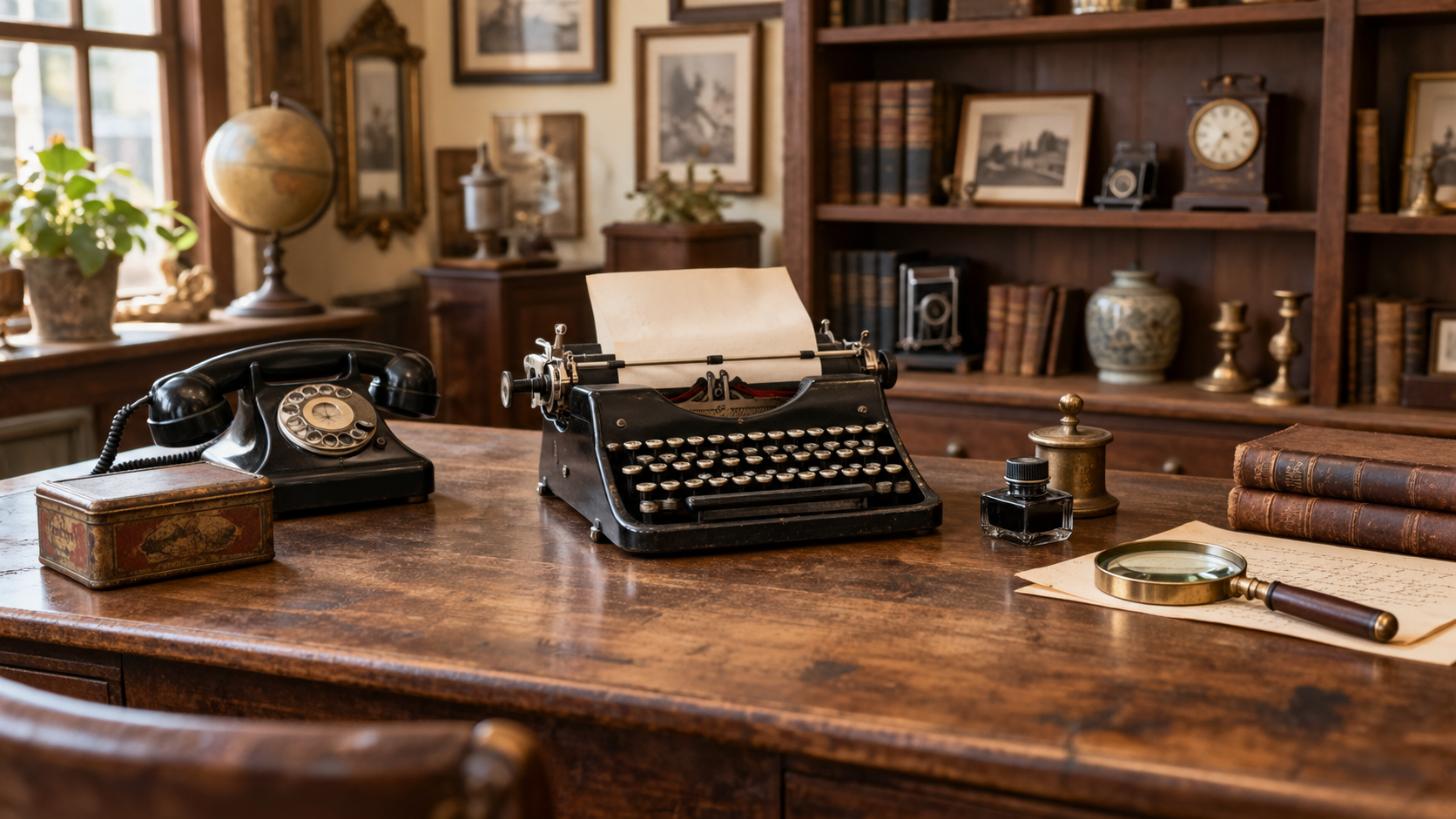
Collecting old objects is more than just finding something that has survived for decades. A telephone can preserve the history of communication. A tobacco tin can reveal how a company marketed a product. A typewriter can document a change in technology and everyday work. That is the appeal of antique collecting: you are not simply acquiring an object. You are learning to recognize its age, context, craftsmanship, rarity, and story. Its Value.
Whether you are starting with one interesting find, building a specialized collection, buying and selling professionally, or simply fascinated by objects from another era, this guide gives you the foundation to collect with greater confidence. In the United States, an object that is at least 100 years old is commonly described as an antique, although terminology can vary between markets and collecting fields.
That 100-year benchmark is useful, but it does not answer the most important question:
What Is Antique Collecting?
Antique collecting is the practice of deliberately acquiring, researching, preserving, and organizing objects because of their age, rarity, craftsmanship, historical importance, cultural significance, design, or collector demand. The word antique comes from the Latin “antiquus”, meaning “ancient”, through Old French and later English usage.
What Makes An Old Object Worth Collecting?
A century-old mass-produced object may have little demand. In contrast, a much younger object can be highly sought after because it is rare, historically significant, visually distinctive, or important to a particular collecting community. That distinction is the foundation of intelligent collecting.
Difference Between Antique, Vintage, Collectible, Retro and Reproduction.
Collectors use these terms frequently, and understanding them prevents a great deal of confusion.
Antique
Generally, an object at least 100 years old. Age is an important part of the classification, but age alone does not establish monetary value.
Vintage
An object associated with an earlier period or recognizable era. Unlike “antique,” vintage has no universally accepted age threshold.
A mid-century telephone, older typewriter, or tobacco advertisement can be described as vintage without being an antique.
Collectible
A collectible is an object that people deliberately seek, preserve, study, or trade because of its desirability, rarity, subject matter, historical association, design, or cultural significance. A collectible does not have to be particularly old.
Retro
A newer object designed to resemble the style of an earlier period. It may borrow the shapes, colors, materials, or decorative details associated with a particular era without being an original object from that time.
Reproduction
A newly made object intended to reproduce an earlier design or object. Reproductions are created to closely imitate the appearance, style, or features of an original, but they are not themselves historical originals.
Replica
A copy made to resemble a particular original. A replica can be historically useful or decorative, but it should not be represented as an original.
Restored
An original object that has undergone work intended to repair damage or return some aspect of its earlier appearance or function.
Repaired
An object that has been fixed, often to restore usability. A repair does not necessarily attempt to preserve historical originality.
These distinctions matter most when buying vintage collectibles, because two objects can look nearly identical while having very different histories and values.
What Makes an Old Object Collectible?
The most common beginner’s mistake is assuming: “It’s old, therefore it must be valuable.” Not necessarily. It depends on several factors together.
Rarity
How difficult is the object to find? An unusual model, short production run, discontinued variation, or surviving example from a limited market may attract specialist interest.
Condition
Condition can strongly affect desirability. Missing components, corrosion, cracks, dents, stains, or alterations can impact value. Condition is always relative to the category.
A rare object with some wear and tear may still be more desirable than a common object in perfect condition.
Originality
Original paint, labels, hardware, mechanisms, finishes, packaging, and components can matter considerably.
Maker and Manufacturer
Some manufacturers developed strong reputations among collectors, thereby adding value exponentially. Knowing the manufacturer can transform an apparently ordinary object into a million-dollar collectible
Provenance
Provenance means the documented history of an object’s ownership or origin. A strong provenance can provide evidence of authenticity and add historical interest.
Design
Certain objects are collected because they represent a significant design period, technological development, or visual style.
Historical Significance
An object associated with a notable business, industry, event, technology, or social period may have importance beyond its materials.
Demand
Perhaps the most practical factor is whether other collectors actually want it. Customer demand can change. Objects that were overlooked for decades can become fashionable, while once-popular categories can cool. This is why antique collectibles should be evaluated as objects within a market and a historical context, not simply according to age.
How Can You Tell If Something Is Really an Antique or Vintage Item?
Identification begins with observation. Before buying or cleaning an unfamiliar object, examine:
- Manufacturer names
- Logos and trademarks
- Patent numbers
- Model numbers
- Serial numbers
- Date codes
- Country-of-origin marks
- Materials
- Construction methods
- Hardware
- Typography
- Labels
- Paint and finish
- Dimensions
- Mechanical components
Photograph the object from multiple angles and record its measurements. Look closely at areas where information is normally found. A manufacturer’s mark hidden underneath an object can be more useful than its general appearance.
For specialist categories, compare the piece with established reference books, manufacturer catalogs, museum collections, auction archives, specialist dealers, and experienced collector communities.
Do Not Clean First
This deserves emphasis.
A collector who discovers an old object may instinctively want to polish it, repaint it, remove rust, or make it look new. That can be a mistake. Original finishes, labels, paint, patina, and other surface evidence may help establish age and originality. Aggressive cleaning can permanently remove information and may reduce desirability. Research first. Clean later if cleaning is appropriate at all.
Original, Restored, Repaired, or Reproduction?
A knowledgeable collector learns to look for evidence of later intervention.
Potential clues include:
- New-looking screws or fasteners
- Fresh paint
- Inconsistent finishes
- Replacement labels
- Modern wiring
- Mismatched hardware
- Reproduction parts
- Uneven wear
- Fresh plating
- Refinished wood
- Components that do not match the period
None of these automatically proves that an object is fake or incorrectly represented. They are reasons to investigate further.
Restoration itself is not necessarily a negative.
A carefully restored object may be attractive, functional, and historically useful. The critical issue is transparency. Ask:
- What was changed?
- When was it changed?
- Which parts are original?
- Which parts were replaced?
- Was the finish restored?
- Was the object modified to make it functional?
For valuable or unusual pieces, documentation of restoration can become part of the object’s history.
How Do You Start Collecting Antiques and Vintage Objects?
You do not need to begin with an expensive purchase. Start with knowledge. Choose one area that genuinely interests you and learn its vocabulary, manufacturers, major models, periods, common variations, and typical problems.Then establish a budget.
A beginner might start with a modest collection and gradually become more selective as knowledge improves. Keep a record of every purchase:
- Date acquired
- Purchase price
- Seller
- Measurements
- Condition
- Manufacturer
- Model
- Serial or identifying marks
- Restoration or repair
- Photographs
- Research notes
Over time, this becomes your personal collecting database. It also makes future buying decisions much easier.
Choose a Collecting Category That Holds Your Attention
Trying to collect “everything old” quickly becomes expensive and directionless. A more focused collection has a story. At Up in Smoke Antiques, several categories offer particularly interesting entry points.
Antique and Vintage Telephones
Telephones combine technology, industrial design, mechanical engineering, and social history.
Collectors can explore early communication equipment, candlestick phones, wall-mounted models, rotary desk phones, and novelty designs, with each category offering its own identifying features and variations.
If telephones catch your eye, continue into The Beginner’s Roadmap to Collecting Antique Telephones, where the subject can be explored in much greater depth. From there, specialist guides can examine:
Vintage Typewriters
Typewriters offer another fascinating collecting field. Collectors can study manufacturers, mechanisms, keyboards, portable designs, office machines, index typewriters, and electric models. A typewriter can be valued as a machine, a design object, a piece of technological history, or a nostalgic artifact. For a deeper introduction, continue to The Antique Typewriters Collectors Regret Not Buying Sooner
Antique Tobacco Tins
Tobacco tins demonstrate how an everyday commercial object can become a significant collectible. Their appeal may come from graphic design, brand history, unusual shapes, manufacturing variations, scarcity, condition, or the cultural history surrounding tobacco advertising.
A beginner should learn to distinguish ordinary examples from scarce variants and understand how dents, corrosion, fading, missing lids, repainting, and other condition issues affect desirability.
Start with Mistakes to Avoid When Buying Antique Tobacco Tins, then explore specialist subjects such as pocket tins, humidor tins, lunch-box tins, and sample tins.
Vintage Tobacco Advertising
Advertising collectibles offer another window into history. Signs, trade cards, cigar box labels, store displays, printed material, and other promotional objects can reveal how companies presented their products and how graphic design changed over time. Collectors may focus on a particular brand, period, advertising format, geographic market, or visual style.
Here you can see Why Antique Tobacco Advertising Is So Hard to Find Now, followed by more focused guides on advertising signs, trade cards, cigar box labels, and store displays.
How Do Collectors Determine What an Antique Is Worth?
There is no single formula that can determine the value of every object. Instead, dealers usually consider:
Rarity + condition + originality + maker + provenance + demand + comparable sales
A useful starting point is to research recent sales of genuinely comparable objects. Look for examples with similar:
- Manufacturer
- Model
- Age
- Materials
- Condition
- Completeness
- Restoration history
- Provenance
Do not confuse a price tag for the final purchase price. An item listed for $1,000 does not establish that buyers are paying $1,000 for it. Prices can be negotiated. Completed sales provide more useful evidence.
Antique Price Guide or Actual Market Evidence?
An antique price guide can help you understand the approximate market context of a category, especially if you are unfamiliar with it. But price guides should be treated as reference tools rather than automatic price tags.
Markets change; conditions vary. Rare versions appear, and collector tastes evolve.
For that reason, combine reference guides with recent auction results, specialist dealer information, comparable listings, and, where available, documented completed sales. The same model can therefore produce different prices depending on where, when, and how it is sold.
When Do You Need an Antique Appraisal?
An antique appraisal is a professional opinion of an object’s value for a specified purpose. That purpose matters. A valuation prepared for insurance may use a different basis from an estimate prepared for an auction or private sale.
A professional appraisal may consider:
- Identification
- Authenticity
- Age
- Maker
- Condition
- Provenance
- Comparable sales
- Market conditions
- Intended valuation purpose
An appraisal can be particularly useful for unusual, expensive, historically important, inherited, or disputed objects.
For ordinary purchases, however, developing strong research habits can often help you establish whether an asking price deserves further consideration.
Where Do Collectors Find Antiques?
The market is much broader than the traditional antique shop. Collectors find objects through:
- Antique dealers
- Specialist shops
- Estate sales
- Auctions
- Flea markets
- Antique fairs
- Private collections
- Online marketplaces
An auction can expose you to rare material and useful sale records. A specialist dealer may provide expertise and provenance. An estate sale may uncover objects that have remained together for decades.
Online buying expands access but places greater responsibility on the buyer to ask questions, examine photographs, verify descriptions, and understand shipping and return policies.
For more on the discovery side of the hobby, you can read the article on Where Collectors Actually Find Rare Antiques Today
How the U.S. Market Connects to the Global Collecting World?
The United States is an important market for collecting, but the objects themselves are international. American collectors encounter British, European, Asian, and other international objects, while American-made advertising, industrial objects, telephones, typewriters, and commercial memorabilia attract collectors beyond the United States.
International purchases may involve:
- Different terminology
- Different dating conventions
- Import requirements
- Shipping restrictions
- Currency differences
- Regional manufacturing variations
- Different market prices
An object described one way in an American marketplace may be classified differently by a European specialist. Good collectors learn to search beyond vocabulary.
How to Build a Collection With a Story?
A collection becomes more meaningful when the objects have something in common. Before buying, decide what connects the pieces:
- Period: Objects from a particular era or historical period.
- Place: Items connected to a country, city, region, or culture.
- Maker: Different works from the same manufacturer, designer, or brand.
- Subject: Objects related to a particular industry, hobby, or way of life.
- Material or design: Pieces connected by materials, craftsmanship, or visual style.
This gives you a simple test for future purchases: Does this object add something to the story, or am I simply buying it because I like it?
How Stories, Provenance and History Change Collecting?
Two objects can be physically similar but historically very different. One may have an ordinary ownership history. Another may have remained with the same family for generations, come from a historic business, or document an unusual aspect of an industry. That history can influence collector interest.
That’s also why photographs, receipts, old advertisements, original packaging, letters, catalogs, and ownership records should not automatically be discarded. They may help explain the object.
How Should You Store and Preserve Your Collection?
Preservation starts with the environment. Protect collectibles from:
- Excessive humidity
- Extreme temperature changes
- Direct sunlight
- Water
- Harsh chemicals
- Unnecessary polishing
- Poor storage materials
- Rough handling
Paper, labels, advertising, and other fragile materials deserve particular protection from light and moisture. Mechanical objects require additional care. Document the condition of valuable pieces before and after any repair or restoration.
Collecting as a Hobby, Business or Passion
Not every collector has the same objective. Although there are as many types of collectors as there are collectors, they all fall under four broad categories mentioned below:
The Hobby Collector
Collects primarily for enjoyment, curiosity, display, and learning. The focus is often on discovering interesting objects, understanding their history, and enjoying the process of finding pieces that have personal meaning.
The Specialist
Develops deep knowledge in one narrow category and becomes familiar with subtle variations. Over time, the collector learns to recognize differences in makers, models, materials, production periods, condition, and other details that may not be obvious to a casual buyer.
The Dealer
Buys and sells with commercial considerations such as acquisition cost, demand, margins, inventory, presentation, and shipping.
The Investment-Minded Collector
Pays close attention to rarity, provenance, market demand, liquidity, and long-term market behavior. These approaches can overlap. A person can begin as a hobby collector and eventually become a specialist or dealer.
Whatever the motivation, product knowledge remains the common denominator.
What Does the Future of Antique and Vintage Collecting Look Like?
The collecting trend is ever-changing, but the basic attraction is not. People still want tangible objects with character, history, and sentimental value. What has changed is how people discover them, acquire them, and buy them.
Digital marketplaces make international inventory easier to find. Online communities allow specialists to identify unfamiliar objects. Digital auction archives make historical price research easier. Social media exposes younger audiences to categories they may never encounter in a traditional shop.
At the same time, physical collecting remains primal.
Collectors still want to handle objects, examine materials, inspect construction, compare condition, attend fairs, visit dealers, and discover something unexpected in person. The future is therefore likely to be increasingly hybrid.
The Collector’s Golden Rule: Learn Before You Buy
Before purchasing an unfamiliar object, ask:
- How old is it?
- Is it Original?
- Who made it?
- Are any parts missing?
- Why do collectors want it?
- Has it been repaired or restored?
- How rare is this particular version?
- Does it belong to the collection of interest?
- Does the condition justify the asking price?
- What comparable examples have been sold?
You will not always know every answer. That’s fine. Not knowing is often the beginning of the most interesting part: research. The important thing is to avoid confusing uncertainty with opportunity, or enthusiasm with proof.
FAQs
1. What qualifies as an antique?
In the United States, 100 years is the commonly used benchmark for describing an object as an antique. However, age alone does not determine whether an object is rare, collectible, or valuable.
2. What is the difference between vintage and antique?
An antique is generally at least 100 years old, while vintage usually describes an object associated with an earlier period without a universal age requirement. A vintage object can be highly collectible without being an antique.
3. How can I tell whether an old object is valuable?
Research its maker, age, rarity, condition, originality, provenance, and collector demand. Compare it with genuine completed sales of similar objects rather than relying only on asking prices.
4. Does restoration reduce an item’s value?
Restoration can affect value, particularly when original material or finishes have been removed. However, restoration is not automatically detrimental. Its effect depends on the object, the quality and extent of the work, and the expectations of collectors in that category.
5. Should a beginner get an appraisal?
Not necessarily. For ordinary purchases, careful research and comparison with recent market evidence may be enough. A professional appraisal becomes more useful for valuable, rare, inherited, historically important, insurance-related, or otherwise unusual objects.