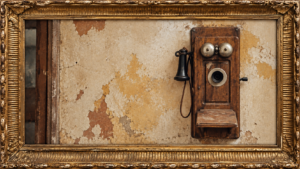

Every wall phone shopper knows the moment. You find a beauty, the photos glow, the price feels fair, and your finger hovers over the buy button. That is exactly when most mistakes happen. An antique wall phone is heavy, old and mechanical in ways modern phones are not, and listings can be vague about the details that matter most.
This guide slows that moment down, so the phone you hang is one you will still enjoy years from now. For the bigger picture, start with our beginner’s roadmap to collecting antique telephones.
What Makes a Wall Phone “Antique”?
The label matters, though less than condition. Collectors Weekly notes that wooden wall phones were made from the 1870s up to World War II. After that, plastic and metal took over.
In listings, “old wall phone” can mean an early-1900s oak cabinet or a mid-century rotary. Both are charming, but they differ in rarity, price, parts and whether they can work today. Ask for the era first, then the maker.
Types of Antique Wall Phones
Three styles cover most of what you will see.
Wooden Crank Wall Phones
The classic: an oak cabinet, bells on the front and a hand crank on the side. Earlier styles, like fiddleback and paddle cabinets from the 1890s, sit at the collector end of the market and usually cost more.
Bakelite Wall Phones
A molded Bakelite case with a dial, often with a deep, glossy finish. Special-order colors are the ones collectors chase.
Compact Rotary Wall Phones
Designed to save space, these are usually the lightest wall phones and the easiest to live with.
How to Tell an Original Wall Phone From a Reproduction
Reproductions have been made for decades, and some phones have been put together from mixed parts. The best defense is evidence.
- Maker’s marks: look for a maker’s name stamped on metal parts. Our antique Kellogg wall telephone, for example, has the “Kellogg” mark on a metal part.
- Weight: originals feel solid and heavy.
- Close-ups: ask for photos of the stamps and the inside of the case. A seller who knows the phone will be happy to send them.
Which Parts Should an Old Wall Phone Still Have?
Make sure you can see the receiver, the transmitter (the mouthpiece), the cords, the bells or ringer, and any bracket or backboard. On crank models, the crank itself matters too.
Some early designs used a separate ringer box, so ask whether one is needed and whether it is included. Also check that the cabinet still holds its working parts, because some old wall phones were gutted and reused as shelves. Missing pieces cost more to replace than they look.
What “Restored” Means on a Vintage Wall Telephone
“Restored” can be good news, bad news, or both. Our 1920 Western Electric 553A wall telephone is a good example. Its housing was bead-blasted and refinished, the dial was calibrated, and it was rewired with brown cloth cords and a modular plug. That work is why it is ready to use.
Restoration also changes originality. Some collectors prize honest age and untouched finishes, while others want a phone that simply works. Neither is wrong. Just ask what was replaced, what was polished and what is still original.
What “Untested” or “For Parts” Really Means
It means the seller has not confirmed the phone works. Our Western Electric 43A Space Saver rotary wall phone is listed as untested and sold as-is for parts or repair, which is why it costs far less than a restored phone. That makes it a good project or display piece, but the wrong choice if you want to plug in and talk. Compare it with a listing that says “fully working,” and you will see why the price gap exists.
Can You Use an Antique Wall Phone Today?
It depends on the phone. Early crank models were built for old telephone systems, so many are display pieces. Restored phones are different. Both the 553A above and the Northern Electric Uniphone below come with modular plugs, and their listings describe them as ready to plug in and use. Whatever you buy, ask the seller directly whether it is meant to be used or displayed. Don’t assume.
How to Hang a Heavy Wall Phone Safely
Wall phones are heavier than they look. Our Kellogg wall phone is solid oak, about 25 lbs, and 21″ tall, 9″ wide and 7″ deep. That weight needs a wall stud or heavy-duty anchors, not a single small screw. Shipping matters too. Bells, glass and wood finishes are fragile, so ask how the phone will be packed.
Up in Smoke Antiques offers complimentary U.S. shipping on orders over $250 and 14-day returns, which helps when you can’t see a piece in person first.
Wall Phones at Up in Smoke Antiques
Each of these is a different type, so you can see the range.
- 1920 Western Electric 553A Wall Telephone: fully restored, with polished Bakelite parts, a calibrated dial and a brass bell. Ready to plug in.
- Northern Electric #2 Uniphone, Burled Walnut Bakelite: a Canadian-made special-order color, fully restored with a calibrated dial and polished brass bells. Very hard to find in this condition.
- Antique Kellogg Wall Telephone, Solid Oak: an early-1900s oak crank phone with its original crank, bells and handset. Authentic, not a reproduction.
- Western Electric 43A Space Saver Rotary Wall Phone: a pre-1940 American-made rotary with its wall bracket. Untested, so it suits repair projects and display.
How to Avoid a Costly Wall Phone Mistake
Read the whole listing, not just the title. A listing called “vintage wall phone” can turn out to be a decorative sign, a modern copy or an empty cabinet. The title sells; the description tells the truth. Check the title, the condition notes, the dimensions, whether it says tested or untested, and the return policy. A few extra minutes up front will save you disappointment later.
Which Wall Phone Is Right for You?
If you want a phone that works today, choose a restored model with a modular plug. If you love old-world craftsmanship, choose oak. If you want something unusual and glossy, a Bakelite wall phone is hard to beat. And if you enjoy a project, an untested rotary is an affordable place to start. Ready to look around? Browse the full vintage telephones collection at Up in Smoke Antiques.
FAQs
- Can an antique wall phone still work today?
Some can. Restored models with modular plugs are made for use, while many early crank phones are best kept as display pieces. - How do I know a wall phone is not a reproduction?
Look for maker’s marks on the metal parts, check the weight, and ask for close-ups of the stamps and the inside of the case. - What does “sold for parts or repair” mean?
The seller has not confirmed the phone works, so it is priced as a project or display piece. - What is the difference between antique and vintage wall phones?
Antique usually means early wooden models from the late 1800s and early 1900s. Vintage usually means mid-century rotary and Bakelite designs. - How should I mount a heavy wall phone?
Use a wall stud or heavy-duty anchors rated well above the phone’s weight, since some solid oak models weigh around 25 lbs.