Few objects capture the character of a bygone era quite like an antique telephone. The upright candlestick, the heavy Bakelite desk set, the satisfying whir of a rotary dial each belongs to a specific moment in the story of how people connected. If you’ve come across an old phone and want to understand what it is, dating it is a rewarding place to start, because a telephone’s design tells you a great deal about its age.
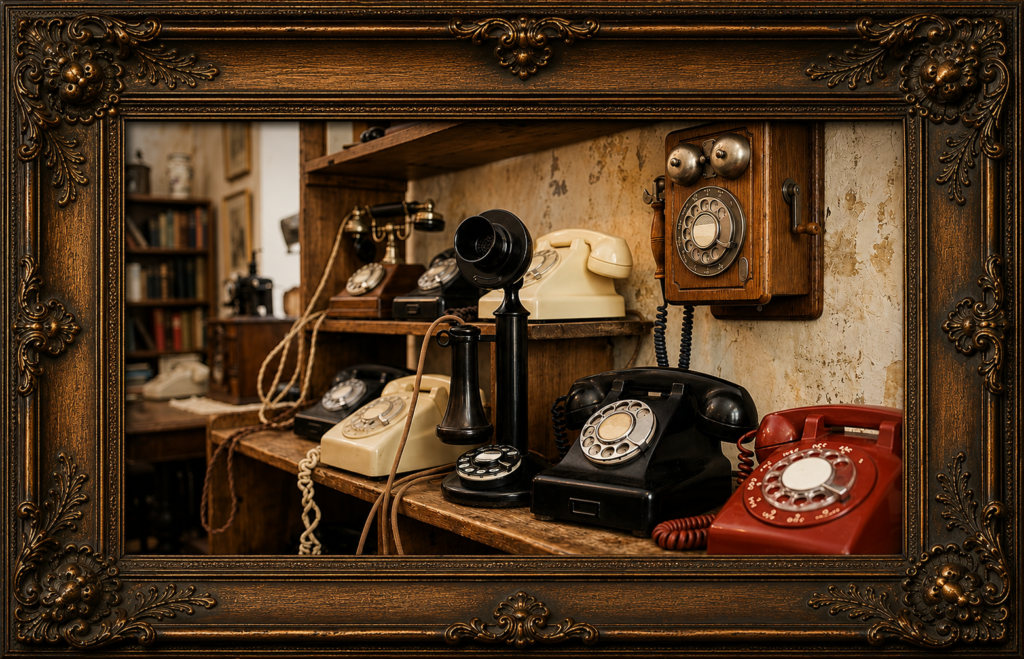
Read the design to date the phone. Telephone styles evolved in a fairly clear sequence, so the form itself is your first clue. The earliest phones, from the 1880s and 1890s, were large, boxy wooden wall sets, often powered by a hand crank. Then came the candlestick — the tall, upright “desk stand” with a separate earpiece hanging on the side which gained popularity from the 1880s onward and became an icon of the early telephone age. Here’s a useful detail: candlesticks didn’t gain rotary dials until late in the 1910s. A candlestick with no dial is generally earlier and was used with a switchboard operator; one with a dial came later. After that, the compact desk sets of the 1930s onward — like the well-known Western Electric models brought every component into a single apparatus.
Learn the major makers. In the American market, one name dominates: Western Electric, the manufacturer for the Bell system. Because they were so widespread, their phones are the ones you’re most likely to encounter, and helpfully replacement parts are the easiest to find. Other important makers include Kellogg, Stromberg-Carlson, and the Swedish maker L.M. Ericsson, whose distinctive phones turn up regularly. Early candlesticks were often made of nickel-plated brass with wooden or hard-rubber parts; later sets used Bakelite.
Know what collectors prize. As with most antiques, age and condition drive desirability, but a few things stand out:
- Pre-1930s phones: the early Western Electric candlesticks and the Art Deco desk sets that followed — are among the most sought after.
- Nickel-plated candlesticks in bright, clean condition are especially attractive.
- Unusual features matter: some early rotary dials lack letters or numbers on the finger-stops, and such variations can be uncommon.
- Original components — the matching ringer box, the correct handset, the original cord — all add to a phone’s appeal.
A note on using them today. Part of the romance of an antique phone is that many still work. Candlesticks were so well made that functioning examples turn up regularly. That said, old rotary pulse-dial phones are increasingly incompatible with modern digital networks, though adapters exist. And remember that the earliest candlesticks were designed to receive calls through an operator, not dial out so “working” means different things depending on the era. If you want a phone for display, the earliest models offer the most drama; if you want one to actually use, look for a later set with its ringer box intact.
Where to learn more. Telephone collecting has a wonderfully devoted community. The Antique Telephone Collectors Association is a superb resource for identification, wiring diagrams, and model histories if you want to go deeper or restore a phone yourself.
Most vintage phones are approachable and affordable, but early candlesticks and rare wall sets in good condition can be genuinely valuable. Whatever you’ve found, its shape, its maker, and its condition together tell you where it sits in the long, appealing history of the telephone.