A vintage tobacco tin’s value lives almost entirely in its appearance — the brightness of its lithography and the integrity of its surface. That makes proper care less of a nicety and more of an investment. Here’s how to keep a collection looking its best for the long haul.
Control moisture above all. Rust is the enemy of tin, and rust needs humidity to form. Store and display your collection somewhere with stable, moderate humidity — not a damp basement, not a hot attic, and not a bathroom or kitchen where moisture spikes. If you live somewhere humid, consider silica gel packs in display cases or a small dehumidifier in the room. Once rust takes hold of bare metal, it’s very difficult to reverse without causing further damage.
Keep them out of direct sunlight. The colorful graphics that make these tins desirable are also vulnerable to fading. Direct sun will, over time, wash out the very lithography that gives a tin its value. Display your collection away from windows, or use UV-filtering glass in cabinets. Indirect, gentle lighting shows the artwork beautifully without slowly bleaching it.
Clean gently, or not at all. When in doubt, do less. Dust with a soft, dry cloth or a soft brush. Avoid abrasive cleaners, scouring pads, and harsh chemicals entirely — they can scratch or strip lithography in seconds, and a stripped tin is a ruined one. If a tin is merely dusty, a dry wipe is usually all it needs. Resist the urge to make an old tin look new; collectors value honest age, not artificial shine.
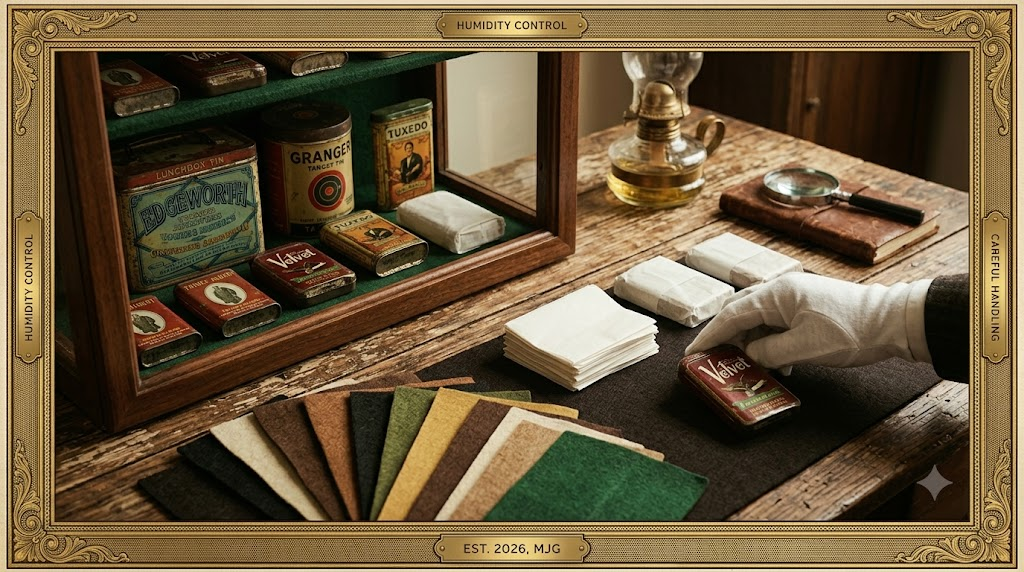
Mind how you handle them. The oils on your hands can, over time, affect metal surfaces. Handle pieces by their edges where possible, and consider clean cotton gloves for your most valuable tins. When moving a tin, support it fully rather than gripping it tightly — denting is permanent.
Store the overflow properly. Not everything will be on display at once. For tins in storage, wrap each one individually in acid-free tissue and keep them in a stable environment, away from anything that might press against or scratch them. Don’t stack tins directly on top of one another where edges can dig into graphics. Treat them, in storage, with the same care you’d give a framed print.
Think about display surfaces. When arranging tins on shelves, felt or soft liners protect both the tin’s base and the shelf. Glass-front cabinets keep dust off and add a layer of protection from accidental knocks — a worthwhile safeguard for a collection that’s easy to bump in passing.
A word on restoration: it’s tempting to want to “fix” a tin with surface damage, but amateur restoration almost always does more harm than good. Repainting, aggressive polishing, or attempts to remove rust frequently destroy the original lithography and, with it, the tin’s value and authenticity. If a valuable piece needs serious attention, consult a professional before doing anything irreversible. For most tins, the right approach is simply to stabilize the environment and leave the piece alone.
The overarching principle is gentleness. These objects survived decades precisely because someone, somewhere, didn’t mistreat them. A little thoughtful care — dry air, soft light, careful hands — is all it takes to carry them forward another generation with their character intact.
Building a collection worth caring for? Browse well-preserved pieces in our shop, or reach out with a care question about something you own.