
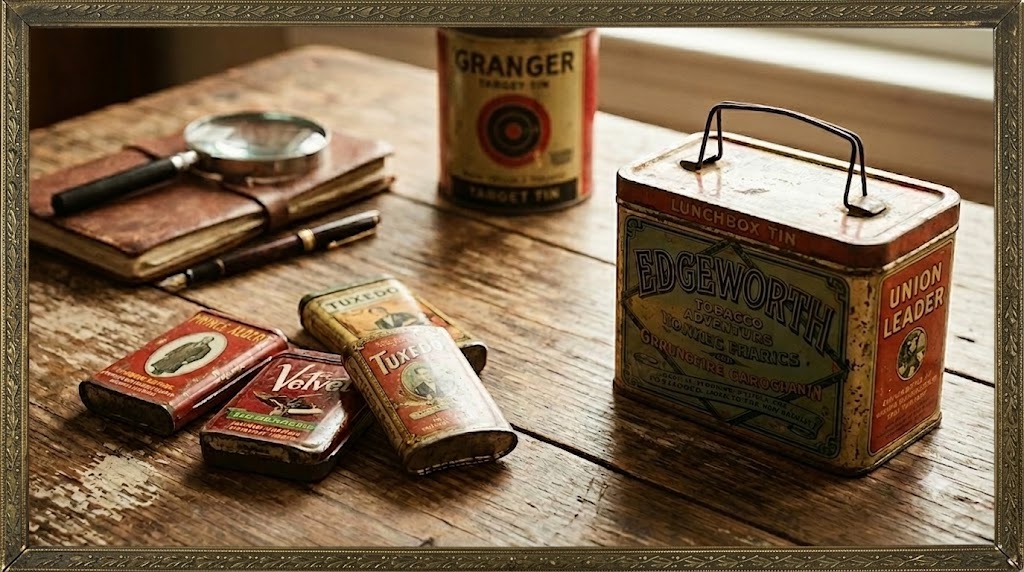
Once you start paying attention to vintage tobacco tins, you notice they come in distinct shapes — and those shapes aren’t arbitrary. Each format was designed for a specific way of buying, carrying, and storing tobacco. Learning to read them is one of the satisfying early steps in collecting, and it helps you make sense of any display or dealer’s table at a glance.
Pocket tins are the flat, slightly curved tins many people picture first. They were made to slip into a pocket, holding a personal supply of tobacco for rolling cigarettes, filling a pipe, or carrying snuff. Their curved backs were shaped to sit comfortably against the body. Because they were personal, everyday items produced in huge quantities, pocket tins are among the most common finds today — and among the most beloved, thanks to their handy size and the bold graphics packed onto a small surface. For collectors short on space, they’re ideal: a meaningful collection of pocket tins fits on a single shelf.
Bulk cylinder tins sit at the other end of the spectrum. These taller, round tins — often in the range of six to eight inches high — were used to store tobacco in larger quantities. When tobacco was sold to retailers in bulk in the late 1880s, tins were even fitted with air holes to keep the contents fresh. These cylinders were the workhorses of the tobacco trade, and their larger surfaces gave manufacturers a generous canvas for advertising artwork.
“Lunchbox” tins are a particularly charming category, and the name comes from how they were reused rather than how they were sold. Practical families would repurpose emptied tobacco tins — along with cookie tins and similar containers — as lunch boxes. These larger, often handled tins were sturdy and the right size for carrying a midday meal. That habit of reuse is part of a broader history: the very idea of the tin lunch box grew out of this practical thrift before manufacturers began making purpose-built lunch boxes of their own. For collectors, handled “lunchbox”-style tobacco tins are prized for their size, their presence on a shelf, and the social history they carry.
Beyond these broad families, you’ll encounter variations: cutter-top tins, novelty shapes, and figural tins like the American Tobacco Company’s well-known Roly Poly character tins from the early 1900s, each lithographed as a different character. Part of the fun of learning the formats is that the categories have texture — exceptions and oddities that reward a knowledgeable eye.
Why does format matter to a collector beyond simple curiosity? A few reasons. Format helps you organize and focus a collection — many collectors specialize in pocket tins precisely because of their uniform size and displayability. Format also offers clues about a tin’s original use and era, which deepens your appreciation of each piece. And recognizing formats quickly makes you a sharper buyer: you can survey a table of tins and immediately understand what you’re looking at, where the interesting pieces might be, and which shapes suit the collection you’re building.
Most tobacco tins were made of tin, but you’ll also find examples in aluminum, brass, cardboard, copper, and steel — another layer of variety to notice as your eye develops.
The shapes, in the end, are a kind of language. Once you can read them, every old tin tells you a little about the hands that carried it and the counter it once sat on.
Curious which formats suit your space and taste? Browse our tins by type, or tell us what you’re after and we’ll keep an eye out.