
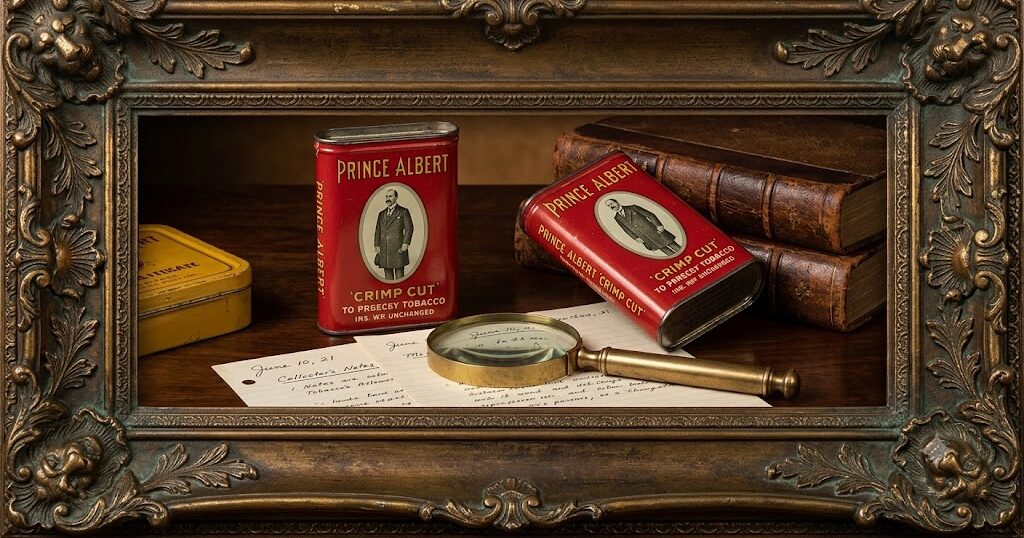
Few tobacco tins are as instantly recognizable to collectors as Prince Albert. If you’ve spent any time around vintage tobacciana, you’ve seen that familiar pocket tin — and there’s a reason it turns up so often, and a reason it remains a favorite even though most examples are modestly priced.
Prince Albert crimp cut became one of the most widely sold tobacco products in America, and the flat, curved pocket tin that held it was produced in staggering numbers. That ubiquity is exactly why these tins are such a common find today. For collectors, this cuts both ways. On one hand, the vast majority of Prince Albert tins are common and worth only a few dollars. On the other, that very availability makes them one of the best entry points into the hobby — an affordable, attractive, genuinely vintage piece that almost anyone can own.
The pocket tin itself tells a story about how tobacco was sold and carried. Flatter tins like these were designed to slip into a pocket, holding a personal supply of tobacco for rolling cigarettes or filling a pipe. They sat alongside the taller cylindrical tins used for bulk storage — a format difference that, once you learn to see it, helps you read any tobacco display at a glance.
What makes Prince Albert worth knowing isn’t rarity — it’s design and history. These tins are a perfect example of how American tobacco companies became early masters of branding. The printing technique that made their eye-catching graphics possible, offset lithography, was patented in 1875 specifically to print on tin, and it transformed humble containers into miniature advertisements. Tobacco companies seized on it, competing to make their tins stand out on a crowded shelf with bold colors, distinctive lettering, and memorable imagery. Prince Albert’s tin is a textbook case of that era’s commercial artistry.
For collectors, Prince Albert offers a few useful lessons. First, it’s a reminder that common and worthwhile aren’t opposites — a well-kept example is a handsome thing to own, regardless of its modest price. Second, it’s a benchmark for condition. Because so many exist, you can afford to be selective: hold out for an example with bright graphics, minimal denting, and a clean finish rather than settling for a worn one. And third, it’s a teaching tool. Studying a known-genuine Prince Albert tin — its exact colors, fonts, and proportions — sharpens your eye for spotting reproductions across the whole hobby.
It’s worth noting that rare variants exist for many common brands, Prince Albert included. The overwhelming majority of examples you encounter will be ordinary, but unusual versions do surface, which is part of what keeps collectors paying attention even to familiar names. The thrill of the hobby often lies in knowing enough to recognize the exception when it appears.
That’s the real charm of Prince Albert. It isn’t the tin that will make headlines at auction. It’s the tin that introduces countless people to collecting, that anchors a display, and that carries, in its softened colors and well-handled edges, a small piece of everyday American history.
Looking for a well-kept pocket tin to start or round out a collection? Browse our tins, or tell us what you’re hunting for.