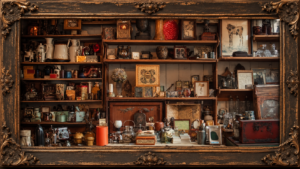

An antique collection rarely begins with a grand plan. Sometimes it starts with a dusty typewriter at a garage sale, a telephone rescued from an old building, or a small tin whose artwork catches your eye. One interesting object leads to another, and before long, you see the world a little differently. But there is a difference between piling up old things and building an antique collection you will be proud of years from now. Experienced collectors learn what interests them, what makes an object special and when to walk away from a tempting buy.
Below are four lessons, three of them drawn from real collectors’ stories, to help you build a collection with curiosity, patience and a little more thought behind every purchase. For the basics of the hobby, see our ultimate guide to antique and vintage collecting.
Lesson 1: Define a Niche Before You Buy
A niche helps in three ways. You learn faster, because you study the same kind of object again and again. You spot fakes and bad prices sooner. And your collection tells a clear story instead of looking like a random pile. Start broad if you need to, but notice what you keep coming back to. That is usually your niche.
Most strong collections have a clear focus. A niche can be a type of object (typewriters, telephones, tobacco tins), a period (Victorian, Art Deco), a brand or even a theme, like advertising antiques from one region.
The smart-buying lesson: Pick a direction early. You can always widen it later, but focus is what turns buying into collecting.
Lesson 2: Look Beyond the Brand Name (Alex Renshaw, Advertising Antiques)
Alex Renshaw, an English collector of advertising antiques, became interested in old signs and commercial graphics partly through childhood visits to antique fairs and car swap meets with his father. His collection focuses on Victorian and Edwardian advertising. He is drawn to elaborate lettering, period images, bright designs and the visual character of objects from an earlier age. In an interview with Collectors Weekly, Renshaw talked about collecting everything from small tins and paper advertising to large enamel signs, and about looking for condition, unusual lettering and striking images.
Differences in graphics, condition and history may be exactly what makes one more interesting than the other. Before buying an old advertising tin, look closely at the artwork, lettering and condition. Are the graphics clear? Does the surface match the claimed age? Are there signs of repainting or reproduction? And don’t confuse visual appeal with market value. A design you love may not be in demand, and a scarce object is not always easy to sell.
The smart-buying lesson: Train your eye to notice details. Learn what separates one example from another before deciding if the price makes sense.
Lesson 3: Research Before You Buy (Richard Polt, Typewriters)
Richard Polt’s typewriter collecting began when he was about twelve. As he told Cincinnati Magazine. At a garage sale, his father bought him a 1930s Remington Noiseless Portable. Polt was learning to type, and the machine’s Art Deco styling stayed with him. He used that typewriter for years before getting seriously into collecting in 1994. His interests grew to cover everything from early experimental machines to modern portables. His story shows how much depth hides inside a familiar object. Typewriters are not all the same machine, with different badges.
Early inventors tried many keyboard layouts and typing mechanisms. A common Underwood No. 5, made in huge numbers, is a very different purchase from a rare experimental model. Before buying a typewriter, research its make, model, production years and special features. Check that the keys, carriage and ribbon mechanism are present and working. Our guide to what to look for when buying a typewriter walks through each check.
The smart-buying lesson: Learn the category before spending serious money in it. Books, specialist websites, collector interviews and experienced enthusiasts all help.
Lesson 4: Understand How the Object Is Made (Gary Goff, Telephones)
Gary Goff’s interest in antique telephones began long before he called himself a collector. As he explained in an interview with Collectors Weekly, as a teenager he got hold of business telephone equipment removed from an old building being torn down and figured out how to connect it at home. Years later, after learning to refinish wood, he found a damaged wooden telephone ringer box in an antique store in central California for twelve dollars. He took it apart and used it to practice refinishing. That project grew into a collection of around forty ringer boxes, and from there into telephones themselves.
Goff’s story shows why understanding construction matters. An antique telephone can look complete from the front while missing parts inside. A cabinet may have been refinished, hardware replaced or parts mixed from different phones. Those details matter differently depending on whether you want a display piece, a restoration, accuracy, or a working phone. Our antique wall phone buying tips cover what to look for.
The smart-buying lesson: Passion helps you find what to collect. Knowledge helps you decide what to buy, what to pay and when to wait.
5 Smart Buying Habits
These lessons point to five habits that improve almost any antique collection:
- Choose a direction. Explore freely, but build real knowledge in the areas that interest you most.
- Research before committing. Check maker’s marks, model variations, dates and specialist references. Compare similar examples instead of relying on the seller’s description.
- Examine condition honestly. Scratches, rust, missing parts, repairs and refinishing all affect appeal. How much they matter depends on the object and your goals.
- Compare real sales. Asking prices show what sellers hope to get, not what buyers pay. Look for sold examples in similar condition.
- Know why you are buying. History, design, nostalgia, display or resale? Knowing your reason helps you avoid impulse buys and overpriced pieces.
Collect With Curiosity, Buy With Knowledge
The best antique collections are not always the biggest or most expensive. They are shaped by understanding, a clear personal interest and the patience to choose well. A tobacco tin, an old advertisement, a typewriter or an antique telephone can each open a window into another time. The more you learn about what you collect, the more meaningful each new piece becomes.
Start with something that truly interests you, do your research, and permit yourself to pass on a purchase that doesn’t feel right. Want more collector wisdom? Read our lessons learned from antique collector stories, or browse the pieces we have now at Up in Smoke Antiques: vintage typewriters, vintage telephones and vintage tins.
FAQs
- How do I start an antique collection?
Pick something you genuinely enjoy, learn the basics of that category, set a budget and buy one good example instead of several weak ones. - What should I collect first?
Start with a category that is easy to find and affordable, such as tobacco tins or common vintage phones. You will learn faster and make cheaper mistakes. - How do I know if an antique is worth the price?
Compare recent sold examples in similar condition, not asking prices. For high-value pieces, ask a specialist or get an appraisal. - How can I avoid buying fakes?
Check maker’s marks, materials, weight and wear. Ask the seller for close-up photos and the item’s history, and walk away if the answers are vague. - Do I need to define a niche to collect antiques?
No, but it helps. A niche makes it easier to build knowledge, spot good deals and create a collection that tells a clear story.